There is often confusion about the various roles of a web engineering team. I have had to explain, even to technical recruiters, the differences between these roles and that the lines that separate them are often fuzzy. I thought I’d share the framework I like to use to evaluate whether someone is a good fit for a startup’s technical team.
In a startup, you can’t afford to have people who are only able to do one thing. Someone could be adept at writing HTML/CSS, but if they don’t have a great eye for design or know JavaScript well, it’s just not worth having them on the core team. Similarly, somebody who knows a little bit of everything but isn’t advanced in anything will just drag the team down.
The size of the company or startup will determine how many different hats each engineer must wear. Many startups get off the ground with a single founder who does a little bit of everything until he or she can grow the team. It’s also possible to outsource some roles completely. Just as cloud-hosting providers such as Amazon Web Services have drastically reduced the need for hardware/network engineers in web startups, platforms like Heroku take it further and (for a price) can reduce sysadmin and DevOps work almost entirely in the beginning.
In pretty much every case, when a startup grows, people will inevitably start specializing. Even those rare gems, who in the early days can spend the first half of the day in Photoshop and the second half scaling a database, will eventually specialize at least somewhat. If you’re hiring well, you’ll always find someone who can outperform you in at least one area.
I’m a big fan of “full stack” people and think specializing too much, too early, is a bad sign for startups. At Elastic, each of our engineers has written CSS and done database/server management. It’s good when a problem arises for there to be more than one person capable of fixing it. That said, I’m spending the bulk of my day writing in JavaScript/Backbone.js because I enjoy it much more than a coworker who’d rather be in Python as much as possible. That’s healthy and it works.
We’ve built this as “sales communication software”, which we believe didn’t really exist before. CRMs (salesforce.com, I’m looking at you!) are inadequate because they are more like databases of contacts than software that really helps you do the selling. We’ve trying to change that by making your sales phone calling and sales emailing experience tightly coupled with your lead data (CRM).
Would love to hear any feedback you have about the product!
I just got a sweet new MacBook Pro Retina – way faster than my old MBP. I wanted to do a clean install rather than restoring from a TimeMachine backup, which meant reinstalling software and manually transferring stuff over that I really needed. I kept a list…
Misc apps:
Set Screenshot location – store screenshots off desktop
defaults write com.apple.screencapture location ~/Screenshots/; killall SystemUIServer
I got to go to Y Combinator’s Startup School this year and had a great time. Between the reception dinner the night before and the day of event I got to meet a lot of great people and reconnect with some I’d met in the past or only talked to online. Most of the speakers were really good.
I took some very brief notes during some of the talks of the 1 or 2 things that stuck out to me as either surprising, motivational, or instructional.
Zuckerberg: He never thought they’d be the people to build what they knew would eventually exist. They expected someone huge to build it, but it turned out none of them cared as much.
Uber: Doesn’t own any cars or employee any drivers, or spend any marketing money. Avg customer spending $105/mo. 50% of all riders have ridden in the last 30 days.
Jessica Livingson: The keys are determination (resilience + drive), rejection, build something people want
Patrick / Stripe: Trying to be the economic infrastructure of the Internet. Build something that enables others and you’ll succeed. Both are addictive: the day to day debates and the high level strategy stuff.
Horowitz: Create something people don’t even know they want that eventually they will need.
Companies follow extreme power law curve
– Needs to generate $100M in annual revenue
– breakthrough idea
– founder with the courage and skill to build the great idea into a great company
– leadership vs management – can you articulate a vision, get people to work for you, and the confidence to make it all believable
Pinterest: 3000 users within first couple months after launch (but most weren’t very active). However, it was XX months to get there before launching.
Joel Spolsky: Do not straddle the line between get huge fast and bootstrapping. But both are good strategies.
Weebly: Worked on it for 20 months before seeing first real traction! Working business model took 3 years.
I did Stripe’s Capture the Flag 2.0 this year, “a security contest where you can try your hand at discovering and exploiting vulnerabilities in mock web applications”.
It was a lot of fun. Some of the levels were quite challenging and I had to figure out how to actually implement an exploit vulnerability that I’d only read about in passing before. Each level makes you both a) figure out what the vulnerability is, and b) actually exploit it. One thing that the Stripe guys did a nice job at was spreading out the challenges between PHP, browser JavaScript, node.js, Python, and Ruby, so that developers from any one language wouldn’t have an advantage.
I did it during the week and spent a couple hours per night on it. There was SQL injection, unrestricted uploads, XSS attacks, and more. For one level I actually (found out later) solved it in a different way than was intended. I noticed that their client-side sessions/cookies weren’t actually secure because an error debug page leaked their secret token. So I got to dig into some source code and learn a little Ruby.
The last level was definitely the trickiest. My source code solution is below. I got it running locally and it ran fairly quickly — I knew I had the correct solution. But that was only half the battle since, on production, there was a lot more “jitter”. My first solution ran all night and never finished. So I made some tweaks, and eventually turned on HTTP Keep-Alives, which made a huge difference and my solution ran in a much shorter time.
Finally, I captured the flag! I was the 202nd person to complete it. By the end only 978 of about 16,000 participants completed it at all, so I will gladly be wearing my free t-shirt!
For a new Backbone.js + Flask project I’m using grunt + grunt-contrib, RequireJS’s r.js, Flask-Assets / webassets for static file (LESS/CSS, JS) compilation. But I needed a good way to get my nicely optimized static files onto a CDN and serving proper HTTP headers.
Using the excellent s3cmd tool, here’s what I came up with.
This example will break for browsers/proxies that don’t support gzip, but this is fine for my needs. Any other solution would either require a custom origin web server or writing different filenames in HTML depending on the request coming in. But since I want to use S3 as my origin this is the easiest/simplest solution.
Since all assets are “built” with a md5 version number hash in the file name, I want far futures headers to cache permanently.
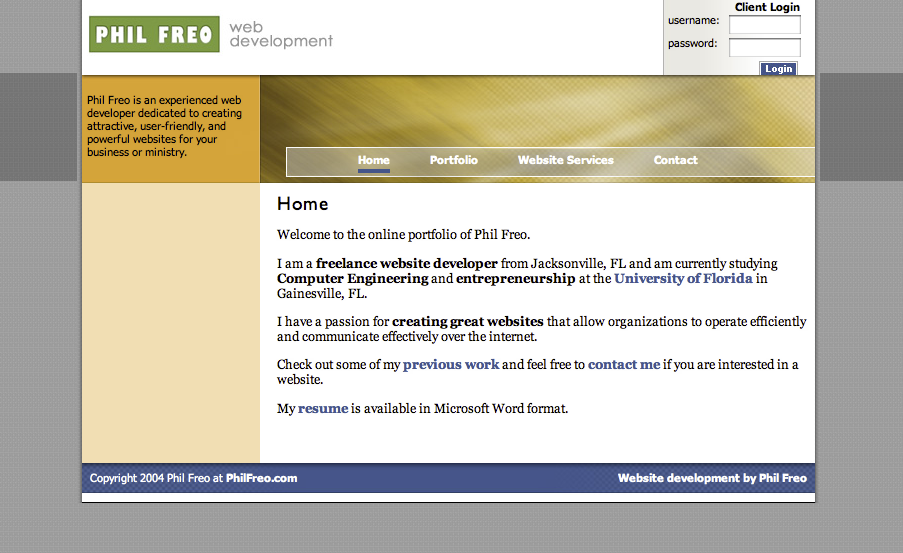
I setup my first personal webpage (philfreo.com) in 2004 when I was in high school. It’s had some server-side includes and a tiny amount of logic written in ASP. It looked like this:
I redesigned it once in 2006 during my Yahoo! internship, and it looked like this:
And there my website sat from 2006 until 2012. That’s forever in internet years!
So here we are in the summer of 2012 – time for a redesign! Nothing too fancy, just clean up the styles to be more modern and representative of the current web. It should tell people about the 2012 Phil Freo rather than the high school or college version of me. It should no longer focused on my freelance website design (where I once dominated SEO for terms like “gainesville web design” and “jacksonville web design”) and now more focused on my work with startups, modern full-stack web development, and my blog.
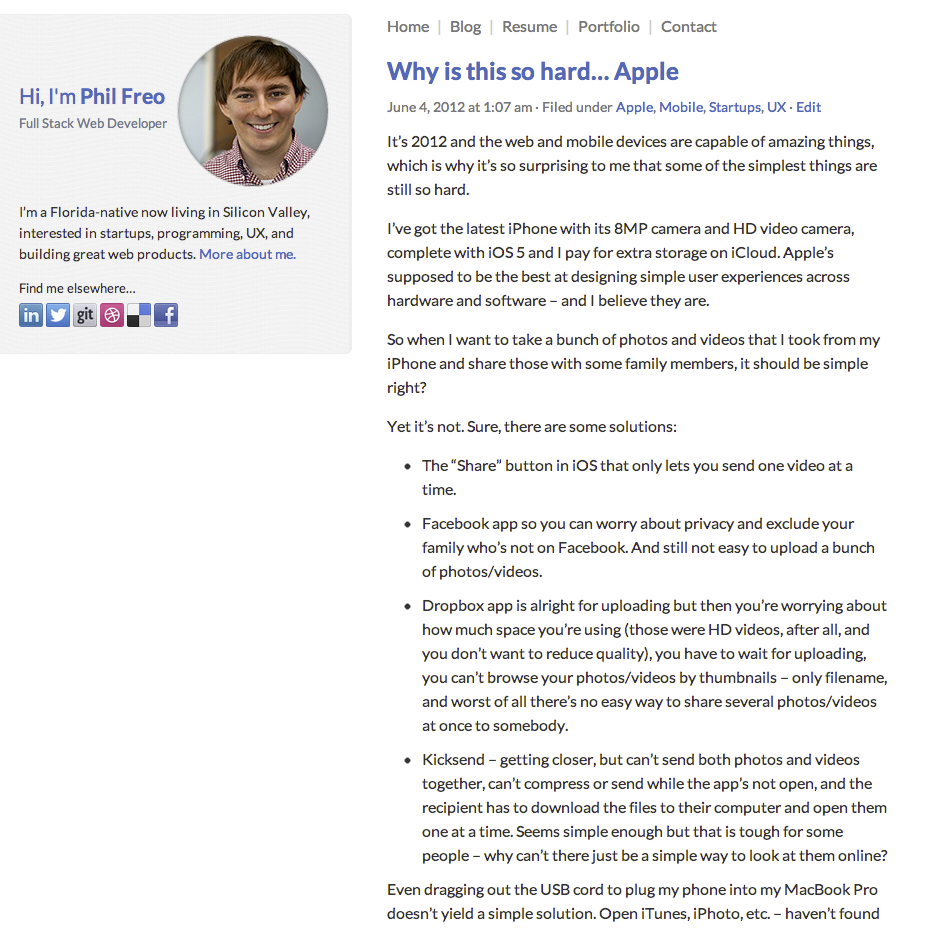
You’re probably looking at the new site now, but for archival purposes, here are some screenshots:
This weekend I upgraded OS X from Lion to Mountain Lion. Documenting steps I had to do to get all my development environments working with MacPorts.
Steps:
First installed the latest XCode via the Mac App Store
Downloaded/Installed Mountain Lion
Launched XCode one to so I could agree to license, etc.
MacPorts also requires the XCode Command Line tools which are a separate install. Inside XCode preferences: “Instead, they can be installed optionally using the Components tab of the Downloads preferences panel as shown in” (source)
Had to run “sudo xcodebuild -license” after getting “Error: org.macports.build for port libunwind-headers returned: command execution failed”. Run this, scroll down, type agree.
sudo port selfupdate
sudo port upgrade outdated
Everything finished and worked properly except MongoDB. Currently there’s a bug and the easiest/best work around seems to be just manually installing the latest stable OS X version from http://www.mongodb.org/downloads and manually copying the binaries into /opt/local
It’s 2012 and the web and mobile devices are capable of amazing things, which is why it’s so surprising to me that some of the simplest things are still so hard.
I’ve got the latest iPhone with its 8MP camera and HD video camera, complete with iOS 5 and I pay for extra storage on iCloud. Apple’s supposed to be the best at designing simple user experiences across hardware and software – and I believe they are.
So when I want to take a bunch of photos and videos that I took from my iPhone and share those with some family members, it should be simple right?
Yet it’s not. Sure, there are some solutions:
The “Share” button in iOS that only lets you send one video at a time.
Facebook app so you can worry about privacy and exclude your family who’s not on Facebook. And still not easy to upload a bunch of photos/videos.
Dropbox app is alright for uploading but then you’re worrying about how much space you’re using (those were HD videos, after all, and you don’t want to reduce quality), you have to wait for uploading, you can’t browse your photos/videos by thumbnails – only filename, and worst of all there’s no easy way to share several photos/videos at once to somebody.
Kicksend – getting closer, but can’t send both photos and videos together, can’t compress or send while the app’s not open, and the recipient has to download the files to their computer and open them one at a time. Seems simple enough but that is tough for some people – why can’t there just be a simple way to look at them online?
Even dragging out the USB cord to plug my phone into my MacBook Pro doesn’t yield a simple solution. Open iTunes, iPhoto, etc. – haven’t found the answer. Dropbox comes the closest with its new “Camera Uploads” feature (which has been out less than 1 year) but still doesn’t cut it when it comes to sharing specific photos/videos after uploading.
Here’s what I would hope for from Apple in 2012:
Buy latest iPhone.
Take photos and videos on iPhone.
Tap a couple buttons to select photos and videos to share.
Choose who to share them with, press Send.
My family gets sent an email link to a webpage with thumbnails of the photos and videos sent, with a one-click way to view each of them. Could even be a native app experience if the recipient is a Mac or iOS user.
What’s important are the things that shouldn’t have to be a part of the process:
No large email attachments or file downloading required for the recipients – a web browser can be a great way to browse media and is certainly the simplest, and Apple has already been killing the file metaphor on mobile.
No long on-screen waiting for uploading or compressing – Apple is already uploading my stuff in the background for Photo Stream so this should be simple.
No special apps to download – Apple has always been a “we take care of all of the basics ourselves” type of company.
No worrying about storage space in the cloud – this is 2012 and disk space is super cheap, and I’m already making Apple gobs of money on the hardware. Fine, I’ll pay extra for iCloud even but it shouldn’t be something I could fill up easily like Dropbox. It should feel unlimited.
As a developer and product designer, I recognize that pulling this off is no trivial task. You’d have to design a whole web app for viewing this media, build a super scalable backend to handle it, make iOS changes, etc. Hardest of all you’d have to make sure this fits into a larger product vision.
But surely Apple with its nearly unlimited resources and great talent should be able to. Sadly, as plenty of people have pointedout, they still don’t get the web like they get hardware and software.
That leaves a big hole for other players to fill. Dropbox, Google, Facebook – you’ve been given a big wide open opportunity to shine, but so far have not impressed. So listen up entrepreneurs, Apple executives, and young dreamers: the field is wide open for better products – have at it!